After emailing different directors/producers in the industry, we received the feedback above. Below, we have videos taken of students between the ages of 14 and 16 discussing our video after seeing it for the first time.
Dance videos are very common, both being released by the artists (either a compilation of fans dancing or their own production, with either the artist or just professional dancers) with Justin Bieber's 'Sorry' being evidence of this. There are several different types that you often see. Some have different cuts and angles, with many people in the room, and many dancers. Others are a stable shot, with only one dancer. The genres of the dancing often vary. Here are a series of examples we have looked at for research:
What we like from this:
the slow and fast contrast
plain, simple backdrop, focus is on the dancing
there are many dance moves that match the lyrics
we will ask our friend to incorporate some of the dance moves that match the lyrics
some sections lip-sync, some don't - links to our music video
Dance videos are a very common example of user generated content (UGC), which is why we have chosen to make one. We have contacted a friend, asking them to create a dance based on this song.
LYRIC VIDEO RESEARCH
There are often channels dedicated to making lyric videos, therefore have no specific link to the artist. There are also channels that are set up as fan accounts for artists. Because of the fan interactions, artists now release lyric videos as another edition of the promotional video. Sometimes, these videos do better, for example 'Closer' by the Chainsmokers. On YouTube, the lyric video is sitting on 2.6b views, while the official music video has 376 million.
Artist released lyric videos often consist of some visuals in the background, however there is never any lip syncing. The lyrics will come up on screen as each line/verse changes. Some are slightly more creative, as there is a visual that comes up as well as the word, for each lyric.
For our lyric video, we will use some footage we have recorded in the background, and match it to the beat of the song. Our plan is to have different coloured lyrics (possibly varying between white, black and green).
VISUALISER RESEARCH
A visualiser video is a video which gives a sense of how the music video for the specific track will be, it gives the audience a sneak peek/teaser of what vibe the music video will create, a sense of how it will look like, and some of the shots that you will see within the music video. Generally, you see a lot of layering, slow-motion footage and slower-paced cuts.
This is a Billie Eilish visualiser. This is quite different to what we are planning on doing because this is a separate animation. Our visualiser will consist of footage that is also going to be in the music video, including visuals of our protagonist and our artist...
REACTION VIDEO RESEARCH
There are thousands of reaction videos to Billie Eilish's music and music videos. These reaction videos vary across all audiences. There are several creative reactions, including:
For our reaction, we will likely choose a couple friends (as they fit her target audience) to react to our final edit as if it were professional. Generally, the format includes the video in the middle of the screen and a person either side, pausing the video to make points. If there is only one person reacting, the video will be in the bottom corner, and the person reacting will be on the other side of the screen.
PRODUCT PLACEMENT
It is very common for music videos (and film) to incorporate product placement into the music video. This is when a brand pays for a product to be either used or placed in the mise-en-scene of a video. A common item in music videos is headphones/earphones. In many videos that we have researched, there are tightframes of a headphone brand, specifically 'Beats by Dr. Dre'. A brand will usually pay for their product to be placed in the context that will appeal to their audience the best. Headphones work for pretty much any music video, as there is a clear music link. The viewers are already looking at music, and if they see their favourite artist wearing something, the brands revenue is likely to increase. It is common across the media industry, with a clear example being the James Bond franchise. The character, James Bond, is known for his fashion, elegance and female gaze, therefore brands will pay for him to wear their clothing line, drive their cars and many more.
For music videos, it is very common for the headphones to be shown for a short close-up lasting around 2-3 seconds, as well as being seen in the mise-en-scene. This is evident in Billie Eilish's song, lovely (with Khalid). As Billie Eilish has already been seen wearing a headphone brand, it made sense for us too use this concept. Although we had no access to Beats headphones, we have other wireless bluetooth headphones called 'TREBLAB XR500'. We have recorded 2 different shots with these headphones. One was a close-up, similar to the image of Billie, and the other with the headphones in the mise-en-scene. In reality, this brand wouldn't be allowed to work with Billie, as it is likely she still has an ongoing deal with Beats, however as we were simply creating a simulacra of her image, it fits well.
Along with putting the product into the video, we will create an advert for the product. As they are bluetooth headphones, we feel it would be best to use them while exercising. Using exercise in the advert links well with the likely audience of the headphones. We are taking inspiration from several headphone adverts we have researched, including:
What we want to take from these videos:
Use of slow-mo
Hard bass music
Close-ups on headphones
Contrast between having headphones vs not having them
We created an audience survey to delve into the target age and gender for the electropop/dark-popgenre. The survey came along with a video to watch first:
This article identifies the similarities between Billie's audience, Khalid's audience and the audience of 13 Reasons Why. It explores Billie's 'blow up', identifying a core reason as her song 'Bored' appearing in the series '13 Reasons Why'. Another reason being her audience similarities with Khalid. All three explore 'teen' issues, including struggles with mental health and relationships. 13 Reasons Why explores a character named Hannah Baker, and explores her suicide voice recordings. Some of Billie's 'bored' lyrics include:
The games you played were never fun
You'd say you'd stay but then you'd run Giving you what you're begging for Giving you what you say I need I don't want any settled scores I just want you to set me free Giving you what you're begging...
These lyrics started her career into the 'dark pop' genre, with the beat contrasting with the lyrics and tone of the song.
Billie secured another major placement, as her song “Bored” was featured in the popular Netflix series, 13 Reasons Why, on March 31st 2017. 13 Reasons Why is, perhaps, a perfect sync for Billie as the demographic of the audience and nature of the show corresponds excellently with her audience and lyrical themes.
Khalid is another artist that fits beautifully with the themes and audience of the show, as well as Billie’s own audience (he was featured in Logic’s hit song, “1–800–273–8255,” about suicide). He has a similar aged and gendered fanbase, is another teen artist, and sings about similar topics in his own unique manner. Below are the demographics of Khalid’s Instagram following…eerily similar to Billie’s shown above. This collaboration, both with Khalid and 13 Reasons Why, epitomizes the incredible results when one finds the right partnership.
This article also provides charts on Billie's demographic, taken from her Instagram following.
In terms of demographic of the audience, according to Nielsen, the show’s audience skews 65% female and 35% male. Furthermore, about 75% of the viewers of the show are 34 years old or younger. Additionally, the show revolves around a teen suicide — fitting for Billie’s lyrical themes (to be discussed). This fit is absolutely critical — Billie didn’t get just any sync placement but one that fits perfectly with her audience. As noted below, Billie’s Instagram following is mostly female and between 13 and 24 years old, beautifully matching the demographic of 13 Reasons Why’s audience.
The majority of her Instagram audience is female, aged 18-24, while the general gender split is 69.7% female, and 30.3% male. The following most popular age group is 13-17, with (at the time of the article being published) Billie being aged at 16-17. I expected the primary audience on Instagram to be the 13-17 age group, as the Uses and Gratification theory suggests her popularity with that age group largely comes from identification.
As her music and audience has progressed, her career paths have matured, with her most recent song being 'No Time To Die'. This song is featured in the upcoming James Bond film. The progression to go from a suicide teen romance Netflix series to one of the film industries most popular film franchises is a clear attempt to expand her target audience, opting to bring in the 25-34 and 35-44 audiences. James Bond is also more popular amongst a male audience, with the genre (Spy/Action) being more appealing to men.
Although the streaming site does not release viewing figures for its shows, TV ratings company Nielsen estimates that more than six million US viewers saw the first episode of 13 Reasons Why's new series in the three days after its release, compared to fewer than three million for The Crown's season two debut. (source)
Latest. The season 2 premiere episode of “13 Reasons Why,” Netflix's controversial teen-suicide drama series, averaged 6.08 million viewers in the U.S. in the first three days of its release, according to Nielsen estimates. (source)
There are already well-established stereotypical traits attributed to Billie Eilish fans. Essentially, many believe that those who frequently document their love for the artist reflect the majority of her following. Sure, the most vocal of her fans tend to imitate – or share – her fashion style; after all, the performer is regularly regarded as a modern fashion icon and role model for younger listeners. Fanbases which appear particularly active and outspoken can be pretty irritable and obnoxious sometimes, but the danger here is that Eilish’s fanbase may prevent older listeners from consuming her music.
This article explores the audience her debut album, WHEN WE ALL FALL ASLEEP WHERE DO WE GO, received, as well as her authenticity as an artist. Similar to Lady Gaga, Billie Eilish has formed a very loyal and dedicated fan base, with many of the young females posting their love for her on different social media platforms. She has a strong influence over her fans, releasing her mercy/clothing line, creating her own art of subculture (largely evolving around the colour green/darker colours, taking in a mix of the pop subculture and the goth subculture).
The question is raised as to whether these 'obsessive' young fans have a negative impact on Billie's attempt to appeal to a wider audience. Considered 'irritable' and 'obnoxious', this excessive social media presence can put off a potential older audience.
Generally, her fans are largely believed to be teenage girls, and of course, that’s clearly the target demographic. The artist is still quite
young herself, and it’s refreshing to see that this target audience has someone like Eilish as a role model – she’s ambitious and hardly the figure of controversy that many young pop stars conform to. The primary issue is that such strong associations with youth culture may alienate older audiences, when in fact, her music may appeal to older audiences who instead just avoid her product under the belief that it’s not for them.
Her tendency to create relatable content for her audience to identify is seen to alienate the older audiences, despite the fact that her music differs from 'generic' pop. Here is a clear example of an older man firmly against Billie Eilish's music and 'movement'.
Quotes include:
"This trash emo drug addict"
"I understand it's a different generation of morons that like this emo garbage"
"If you guys are fans of that horrible horrible music, then that's fine. You've got to take the L though. You know that music is trash"
Her debut album is actually a pretty accessible and interesting record, boasting some alluring material. It’s a shame to think that many older audiences have already shrugged it off because they think it’s for teenagers. This attitude will affect Eilish in the long run, as she’s already established that she wants to grow as an artist. Sometimes, in these cases, the fanbase doesn’t grow with you; they may just latch onto the next trend when it comes. Yet, Eilish clearly strives to be much more than a passing trend. It’s an impressive debut of wide appeal, but as things stand, it’s unlikely to reach as wide an audience as it perhaps should.
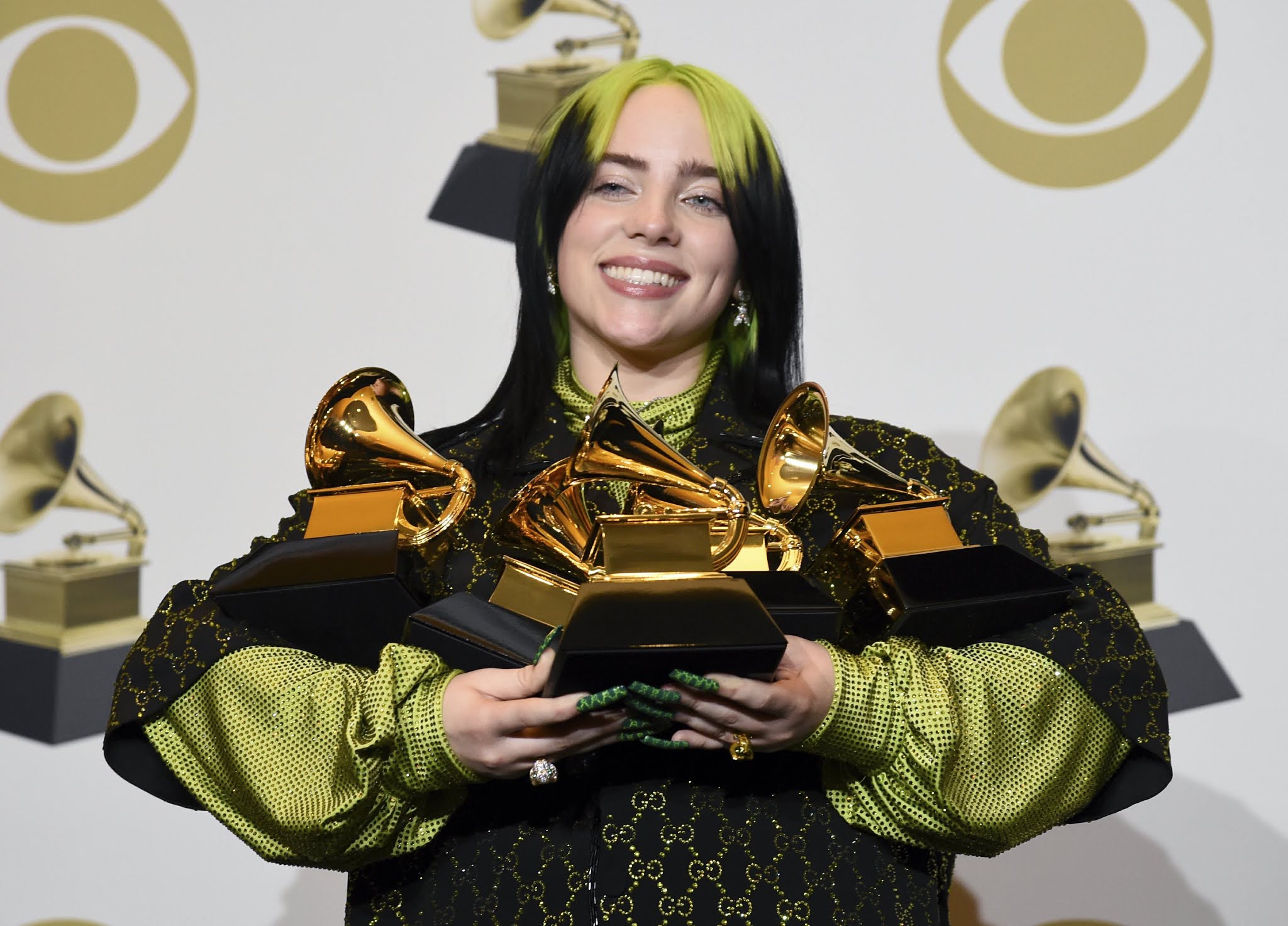
This article highlights her approachability and relatability. It covers her instagram posts, comments and style of language, emphasising her similarities to 'normal' teenage social medias. After winning 5 grammy's, she captioned her photo (of her holding the awards) with, "5 ARE YOU KIDDING ME". This unprofessional style of caption is highly relatable, as it is clear that she shares the shock and excitement with her young fanbase. This means that when her audience read this, they engage with the post, often liking, commenting or sharing the post. Her language matches the normal 16 year old teenagers language, and this image of Billie Eilish is created to connect with these fans.
In her captions, Eilish shows her fanbase she’s just another girl on the internet, fluent in internet-speak. Dragged out words like “NOWWWWW” and the slightly hysterical tone in “FIVE ARE YOU KIDDING” mimic speech, it is as if Eilish is talking not writing.
In others, she writes in lower-case entirely - vague phrases like “been gone” or “careful who ya talkin to” that come across as fragments of thought.
These captions sit well on Eilish’s instagram page, but would easily fit in as some 16 year old teenager’s snapchat caption, or as tweets on any young person’s twitter feed.
The article draws the similarities/differences between social media platforms, comparing Billie Eilish to Ariana Grande. Ariana Grande follows a theme (monochrome) on her instagram, whereas Billie Eilish posts random pictures, with no filters and no specific captions. It appears that, as she is a young celebrity, she is in charge of her social media (continuing the identification theory), whereas Ariana Grande's social media is controlled by her record label.
Examining results from our image semiotics model, no clear clustering was found for Eilish’s instagram pictures. Unlike most pop stars who cycle through various “themes” for their instagram - for example, Ariana Grande’s mostly monochrome feed with occasional glam selfie shots, Eilish’s profile has everything from media shots of her to shots of her leaning against an abandoned mattress in a street alley. A lot more real. And way more approachable.
Screengrabs of her music video/advertising collateral are followed promptly by a post showing her slumped down in a seat, with a Rick and Morty backpack. A picture of tour dates is preceded by a shot of Eilish leaning against the railings, in baggy ordinary-looking clothes and messy hair.
Eilish’s instagram aesthetic ranges from celebrity-like content such as magazine covers and paparazzi pictures to the homemade and common, showing her audience that she knows she’s not exactly a regular person with a regular life, but yet is relatable.
This link takes you to a reddit page, with the question being posed to the sites users. Generally, reddit have a slightly older audience in comparison to most social medias, therefore some of these opinions might be negative, reinforcing the opinion shared in the earlier article, stating older audiences are put off by the 'obsessive' fans. Here are some of the responses:
"10-20ish year old girls and gay boys. A LOT of younger teens who are vicious and will do anything to see her or get closer etc. and mom’s who will encourage their kids to do so. But I highly recommend even with the kinda shitty fans. Billie is an amazing performer"
"i think its probably 12-16 year old girls. thats my personal experience though. it also seems to be the main demographic that attends her concerts."
"I'm glad I'm not the only one wondering.. I'm 24 and my roommate is 27 and we really wanna go.. but volunteering myself to be around 16 yo girls and boys with their parents goes against everything I believe in LOL"
"No one older than 25 unless its a parent. I’d say there was 1 boy every 7 girls."
All of these examples seem to be fans of Billie Eilish and her music, however are overshadowed and put off by her younger audience. This suggests that her secondary audience could be the same that was suggested through an analysis of her instagram demographic, being 25-34. This may not be the type of fan to buy merchandise, or attend shows (pushing into the front row), however sit back and enjoy her music.
WEB 2.0: AUDIENCE ENGAGEMENT
LIVE CONCERT AUDIENCE
I have put together this powerpoint to identify the leading audience to attend a Billie Eilish concert. It is clear that there is a certain demographic that attend her shows. Young females (and occasionally males) at the front. Towards the back, you have the secondary audience, with less desire to scream her music, and more desire to hear her sing. This information gives us detail over her most dedicated fans, meaning we will adapt our products to fit the appeal.
AUDIENCE MEMBERS MOODBOARD
I have put together two different moodboards on what our target audience would wear, watch and listen to. I have made one for males and one for females.
MALE
FEMALE
BBFC
We had to take into consideration the BBFC. Technically, Billie Eilish isn't from the UK, so her videos wouldn't come under this agreement. However, we still wanted to abide by their regulations for our video. Our video isn't explicit in any way, but it is a bit risqué, so parents may want a rating on this video. I think the BBFC may rate this a 12 or less, so it wouldn't affect our target audience.
Brief history incl. discography + chart status + (sub-)genre/s
Record label/s
Social media, streaming (+audience)
Brand/image summary + possible influences
Media appearances (+audience)
Existing texts: vids, digipak, website, merch
BILLIE EILISH
BRIEF HISTORY incl. DISCOGRAPHY + CHART STATUS + (SUB-)GENRE/S
Billie Eilish doesn't have a great deal of music put out, compared to other "dark-pop" artists, such as Lana Del Ray, who has 6 studio albums and 35 singles. Having said that, Eilish's music reaches a mass audience with her album When We All Fall Asleep, Where Do We Go? (2019) reaching number 1 in the charts in the US, Australia, Austria, Canada, Denmark, the Netherlands, Norway, New Zealand, Sweden and the UK. Her singles often reach top 10 in Australia and New Zealand. Eilish's two most successful songs are Bad Guy (2019) reaching number 1 in the US, Australia, Canada, Norway and New Zealand and Therefore I Am (2020) reaching number 1 in New Zealand.
Billie Eilish signed with Darkroom/Interscope when she was only 14 years old. Interscope Records are a subsidiary of one of the big 3 conglomerates that dominate the music industry, being Universal Music Group. Interscope Records have signed many big names in the music industry, including Eminem and 5 Seconds of Summer.
I think a few good artists which have a slightly similar feel to Billie Eilish to look at would be: Ama Lou, Cloves, Lana Del Ray, renforshort & YUNGBLUD.
SOCIAL MEDIA, STREAMING (+ AUDIENCE) & BRAND/IMAGE SUMMARY + POSSIBLE INFLUENCES
Continuation to the Vanity Fair interview (4th year):
MEDIA APPEARANCES (+ AUDIENCE)
As shown in the powerpoint above, Billie Eilish goes on Vanity Fair's YouTube channel annually for an interview where they ask the same questions. She has been on it for 4 years now.
Billie has been on the cover of Vogue 3 times with a fourth digital exclusive.
She won 5 Grammy's in 2020.
Eilish has been on numerous talk shows including The Tonight Show Starring Jimmy Fallon, The Late Night Show, Ellen, Jimmy Kimmel Live and many more.
 REACTION VIDEO RESEARCH